Nepal-style disasters in New Zealand and elsewhere
September 5, 2026

The NZ Herald editorial writers have gone full “climate Chicken Little” in the wake of the Nepal glacier flood tragedy.
In an editorial published this week the newspaper has nailed Nepal clearly to its climate poster-board:
“Scientists from around the world have said this was the largest glacier flood they have witnessed, warning that it is the catalyst for more to come from human-driven climate change. Witnesses said, ‘Nobody expected that.’ Except science has warned us of this repeatedly. We are just not listening, even in the face of such horrors and of irrefutable evidence.”
The problem is, the Herald, like many climate opportunists, overlooks history and the physics of glaciers.
“Could” global warming have played a part? Of course. But so could cooling. That’s the problem – events like these are almost inevitable regardless of which way the climate is pointing on any given day. Fools rush in where angels fear to tread, and I would ask readers to consider the following facts before reaching a view.
Firstly, there’s the issue of fluid dynamics. Glaciers are rivers of ice, moving constantly. Gravity is constantly pulling them downhill, while snowfall at the top replenishes them.
Mountaineer E E Muir wrote of New Zealand’s Southern Alps in 1931:[i]
“We at last reached the wholly remarkable and wonderfully beautiful Hochstetter Icefall, half a mile wide and over 2,000ft high, whose only rival in the Southern Alps is the Great Icefall of the Franz Josef Glacier on the West Coast.
“Broken into fantastic séracs and pinnacles, iridescent and ablaze with jewels in the brilliant sunlight, this great icefall drops steeply down into the Tasman Glacier and is always an awe-inspiring spectacle as it avalanches repeatedly over a rock cliff on the left, 500ft high.
“While we were there, a huge block of ice from the vertical ice cliff above broke away with a tremendous boom and, in a prolonged roar, was sent headlong over the rock precipice and dashed into billions of fragments, which cascaded prettily down in milky white, as of foam, completely covering the rock face and ending in dross below.
“So it has been avalanching throughout the ages, and still the battered rock face stands.
“But beautiful as the Hochstetter Icefall is, it is still more beautiful to look up at the great white peak of Tasman, 5,000ft higher still, completely covered in great hanging glaciers, and, on the left, at the gigantic wall of Cook reaching up another 600ft higher still.”
It follows, as a matter of logic, that edges of glaciers clinging precariously to kilometre high mountain cliffs will, from time to time, crash into the valleys below them regardless of whether the glacier is advancing (growing) or retreating (melting). In some respects, ice falls are more likely with advancing glaciers, but conversely the withdrawal of ice from a mountain edge also removes the “gluing” effect of frozen water on the terrain and can make it vulnerable to landslides.
Glaciers move in two directions. The one thing they don’t do is stand still.
It will be months before scientists get an accurate handle on what triggered Nepal, but it’s far too simplistic to be drawing a line between warmer temperatures and glacial collapse and proclaiming “voila”.
Which brings us to the second issue overlooked by the media and climate activists: history.
The definition of “climate change” is right there in the name: has there been a measurable change in these events as a result of higher temperatures?
It may come as a surprise, but New Zealand has experienced its fair share of glacial floods, and most of them occurred in our cold, low carbon past a century ago. In the first incident we’ll look at, warm summer rains melted the surface of the Mueller Glacier, sending floodwaters into the Hermitage at Mt Cook.
The first hint of what was to come was published 6 January 1913:[ii]
“Guests at the Hermitage enjoyed a grand and novel sight a few days ago. The Hooker River still flows into a tunnel beneath the Mueller Glacier. During a recent nor’-wester the tunnel became blocked and the river was dammed back for some time. Then, breaking a way through again, the rush of pent-up waters tore away hundreds of tons of ice and swept it down the river.”
Two weeks later:
HEAVY RAIN
BUILDING DAMAGED AT HERMITAGE[iii]
(By Telegraph.—Press Association.)
TIMARU, Monday, January 20.
News was received from the Hermitage to-day that for the past eleven days heavy rain has been experienced there, and tourists are unable to get about.
On Sunday there was an exceptional downpour, and what with the rain and melting of the snow all the creeks in the Upper Tasman Valley were flooded, and the road much damaged.
At the Hermitage an overflow from Mueller Glacier covered the floor of the building and damaged the approaches.
It is doubtful whether motorcars can get beyond Glentanner for a while. To-day the packhorse could not face the creeks, which were rolling down heavy boulders.
A follow-up report two days later added a bit more eyewitness detail.[iv]
“The flood of Sunday was quite phenomenal, and a rush of water came suddenly from the Mueller Glacier through an old breach in the moraine towards Kea Point, and covered a large area with big boulders. A track had to be made through these.
“A car bridge on the route was not injured, but some trifling damage was done to the approaches. Since Sunday the weather has been very fine.”
Then, as guests were finally evacuated:[v]
“After ten days of continuous rain over the ranges and valleys about Mount Cook, the wet weather culminated on Sunday afternoon in a torrential tropical downpour, with lightning, thunder, and a heavy gale. This lasted without intermission all night and during Monday until the evening, when it eased off.
“On Sunday evening the Mueller River burst up through the glacier and, breaking through the moraine, came down in a roaring torrent past the Hermitage, carrying with it trees and large boulders. It broke down the fences or piled up boulders against them, carried away the footbridges, tore out a deep channel for itself along what had been the main road, quite cut it, and strewed rocks over about an acre of grassland used as an approach to the Hermitage, rendering it quite impossible to get away at all while the roaring torrent rushed by, and leaving the track impassable for vehicles for some three miles down the valley.
“…And our experience was indeed unique, for we have seen what has not occurred for many years: the Hooker River and other large mountain streams with their courses completely changed, and many acres of grasslands covered in a few hours with thousands upon thousands of tons of rocks and stones of all sizes, ranging up to tons in weight.”
Just two months later, an even bigger disaster struck, when a cyclone dumped 19 inches of rain (483mm) on the same area:[vi]
A GRAPHIC DESCRIPTION
[From Our Correspondent.]
HERMITAGE, March 29.
The storm which commenced at the Hermitage on Wednesday night continued unabated yesterday. Rain fell in torrents, and spray and fog completely shut out the view of the ranges.
The Hooker River was in high flood and made a magnificent spectacle. Blocks of ice 20ft wide from Mueller Glacier rushed down with great velocity, jolting like pebbles and making thunderous reports.
The overflow from the Mueller Glacier turned many acres in front of the Hermitage into raging streams. Trees and boulders of immense size raced along, taking fences before them.
On several occasions water entered the main building, but subsided as the stream broke through fresh ground. The front of the building was rendered uninhabitable, and the management met the position by removing visitors to the rear portion.
At four o’clock in the afternoon, a raging stream several feet deep entered the front wing, and it appeared only a matter of time before the foundation would be swept away. A washhouse standing 20yds away was washed off the concrete foundations and cast headlong into the stream, and was lost sight of for a few minutes.
After this, anxiety grew as to the fate of the main building. The water continued to keep to a confined course clear of the main building. When darkness came on the rain continued to fall incessantly, but the barometer gradually rose from 28.52, and hopes were entertained that the storm was abating.
An inspection of the front wing showed that the foundations were subsiding rapidly, the earth being washed away, and a few minutes after midnight the building began to sink. Finally, with a loud crash, the front toppled over into the stream, which had now a depth of eight feet.
The superintendent had already arranged for a watch to be kept during the night for the safety of visitors, and fortunately the storm was not attended by further disastrous results.
Early this morning the rain eased somewhat, and it was not long before the floods dispersed. At breakfast the sun shone, and everyone took the opportunity to view the damage. The front of the Hermitage was a quagmire. Great boulders lay as far up the gully as the eye could see, and the water had washed out all vegetation.
The motor shed and motormen’s quarters suffered badly and were rendered practically useless for the remainder of the season.
The roadway for miles is completely carried away, and the approaches to several bridges have gone. Mr Sinclair, the contractor for the new bridge over the Hooker River, has suffered heavily, having lost a great deal of material, the pile-driving gear and an engine.
The rainfall for the past twenty-four hours was 9.27in, and over 19 inches fell in forty-eight hours. Reports that have been received state the road is badly damaged, and some difficulty will be encountered in getting back to the railway. Probably it will be the middle of the week before the road is passable.
Again, a follow-up report added fresh details:[vii]
REASONS FOR THE FLOOD
A plausible reason for the flood at the Hermitage is given by local residents. They say that the water from the Mueller Glacier was in so large a volume that the subterranean passages which had largely assisted to carry it away to the Hooker River were unequal to their task, and the water broke a new passage for itself and came down on the eastern side of the mountain range, inundating the Hermitage.
Now that this way is broken, the danger of a flood at the Hermitage is rendered ever-present. A new bridge over the Hooker River, which was in course of erection, was washed away. The bridge would have been open for traffic at the end of the month, but it is improbable that the Government will now build it in the same spot.
The road just outside the Hermitage, …previous to the floods the road had been a good one, but now it was strewn with huge boulders and had sudden “corduroy-like” bumps in it, some of them five feet deep and twelve feet wide.
The amount of rain that fell in the locality of the Hermitage is not realised by many people. The rain gauge showed 19.10 inches for forty-eight hours, but in reality the figures were for forty-two hours, since for six hours of the forty-eight there was no rain.
At Lake Pukaki a very large number of swans were observed, and it was surmised that they had come down from the higher levels to escape the ice. Ice, indeed, was coming into the lake in large quantities by way of the Hooker River, and the river had risen eight feet since the flood.
Then, three years later in March 1916, it was the Tasman Glacier’s turn to collapse in a Nepal scale flood:
TASMAN GLACIER.
BLUE LAKE DISAPPEARS.
FILLED UP BY SLIP.
Disaster has overtaken the piece of water known as the Blue Lake, between the Hermitage and the Ball Hut, in the Mount Cook district of the South Island. This news is confirmed by the following extract from a private letter recently received in Dunedin:—
“On Friday evening, March 3, one of the guides who had been packing stores to the Ball Hutt came in and said that the Blue Lake had disappeared! We could not believe this, but he went on to say that the Tasman Glacier had burst through the moraine, and had sent an enormous volume of water and rocks down, filling up the lake and playing havoc with a portion of the track. He said the water was flowing down through the luncheon place, so things generally sounded very bad.
“To-day Mr. and Mrs. Graham and I arranged to ride up and see what it looked like, and were joined by two Auckland ladies. We got away about twelve o’clock. It was fairly hot riding up the Tasman. We had lunch about two o’clock at the luncheon place, and then walked on to see the damage. The whole Blue Lake is filled up with moraine, and there is a large break at the Tasman side of the valley, which leaves exposed a big face of ice. We scrambled up the hill, and then found the cause of all the trouble to have been a large lake in the glacier itself.
“This must gradually have percolated through the moraine into the Blue Lake, which evidently must have been its outlet, until there was no longer sufficient support to hold the hill, which then gave way, and allowed the water through. I should imagine the glacier lake to have been 400ft long, and possibly 80ft deep. It is now merely a huge hole, almost empty, and with stones falling into it like the sound of guns going off.”
The lesson from these New Zealand examples is that flash glacial floods can and have hit this country when it was 1C colder, and had towns and villages been in their paths many lives would have been lost. The implied requirement from NZ Herald and others that these events must be caused by anthropogenic global warming is a crock – they’ve been happening long before CO2 levels rose.
When it was colder, it was common for glaciers to advance across existing rivers and streams, creating so-called “ice dams” that then built up water behind them and eventually burst when the water had weakened the ice enough.
As the climate warms, glaciers start to retreat and melt, leaving behind pools of water as glacial lakes. More of these lakes are emerging, and have been emerging, since glaciers began to melt - not in the 2000s as popularly assumed but back in the 1800s as the Little Ice Age ended. Melting glaciers are associated with moraine and bedrock dam bursts, not ice-dams.
A 2025 study in Nature of all glacial lake outburst flood (GLOF) events since 1990 finds that far more glacial bursts happen from “ice dam” events than melting glaciers:[viii]
“We found that ice-dammed lakes were the main source of GLOFs, accounting for 92% (n = 1,550) of all reported events. This high proportion is due to the repeated filling of, and outbursts from, these lakes: 127 ice-dammed lakes burst out at least twice and 61 lakes more than 10 times during the study period. Ice-dammed lakes have caused almost all of the reported outburst floods in northwest North America, Iceland and Scandinavia. In contrast, only a handful of moraine-dammed lakes have failed twice or more because the escaping water irrevocably erodes or destroys the dams, reducing the chance of similarly large subsequent outbursts.”
The study finds, “counterintuitively…no increasing trend” in GLOFs since 1990.
“While atmospheric warming, glacier retreat and lake growth constitute an emblematic cryospheric hazard cascade, we found no evidence that this process chain has translated into GLOFs from larger lakes during our study period.”
A 2018 study found a high number of GLOFs in the 1930s, and a decrease since then:[ix]
“We observe a clear global increase in GLOF frequency and their regularity around 1930, which likely represents a lagged response to post-Little Ice Age warming. Notably, we also show that GLOF frequency and regularity – rather unexpectedly – have declined in recent decades even during a time of rapid glacier recession. Although previous studies have suggested that GLOFs will increase in response to climate warming and glacier recession, our global results demonstrate that this has not yet clearly happened.”
By week’s end, climate change as the main cause of the Nepal tragedy was being quietly downplayed, even by the Guardian in the UK, which acknowledged satellite photos indicate a bedrock failure, where the mountain has literally cracked under the weight, so it’s literally a landslide with a portion of glacier thrown in for good measure.
[NOTE: Story can end here]
A quick summary of glacier collapse from around the world will illustrate how ice and rock have always fallen off mountains.
1818:[x] One of the most famous catastrophes of the kind occurred in Switzerland in 1818, when a glacier dammed the Dranse. An attempt to drain the lake thus formed was unsuccessful, and when the dam burst the water came down the valley and nearly wiped out the town of Martigny.
An even worse flood of the kind took place in India in 1841. A great landslip in that year blocked the upper valley of the Indus. No one knew or guessed what had happened, and the coming of the flood was the first intimation of danger. A Sikh army corps which happened to be encamped in its track was practically wiped out.
1890:[xi] BURSTING OF A SWISS GLACIER
The Swiss Vaterland reports that the Marjolen Lake, which lies at the foot of the Eggischhorn, in the Upper Valais, had burst the glacier dam which lay across the valley and, spreading over the glacier, had poured a black mass of mud, stones and broken ice into the Rhone below.
Fortunately, there was little water in the river at the time, otherwise the consequences might have been very calamitous for the people of the Upper Valais. A peasant who was close to the lake at the time declares the scene was most terrible and indescribable.
When the ice dam gave way, the vast mass of water came tumbling out, sweeping away the huge fragments of the glacier with the rock upon it, tumbling into the crevices, bursting them up in turn, and rising over the glacier in gigantic waves, again to carry all before it.
Just at the end of the glacier the valley had narrowed into a little defile, while the face of the glacier was some hundreds of feet high. The water seemed to have tunnelled under the ice, which, attacked above and below, gave way at last with a deafening crash, while the flood hurried down the mountainside into the Rhone.
The lake was nearly 8,000 feet above sea level, and usually discharged its surplus water by subterranean channels, occasionally bursting its ice barriers, as on the present occasion.
The cantonal government is constructing an overflow canal, which, it is hoped, will put an end to those periodical outbursts.
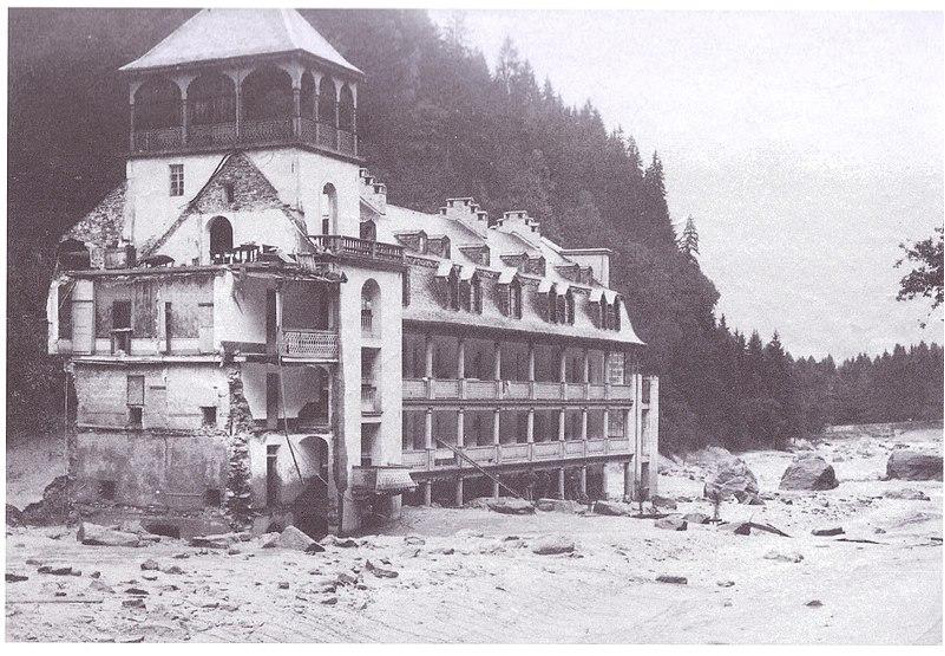
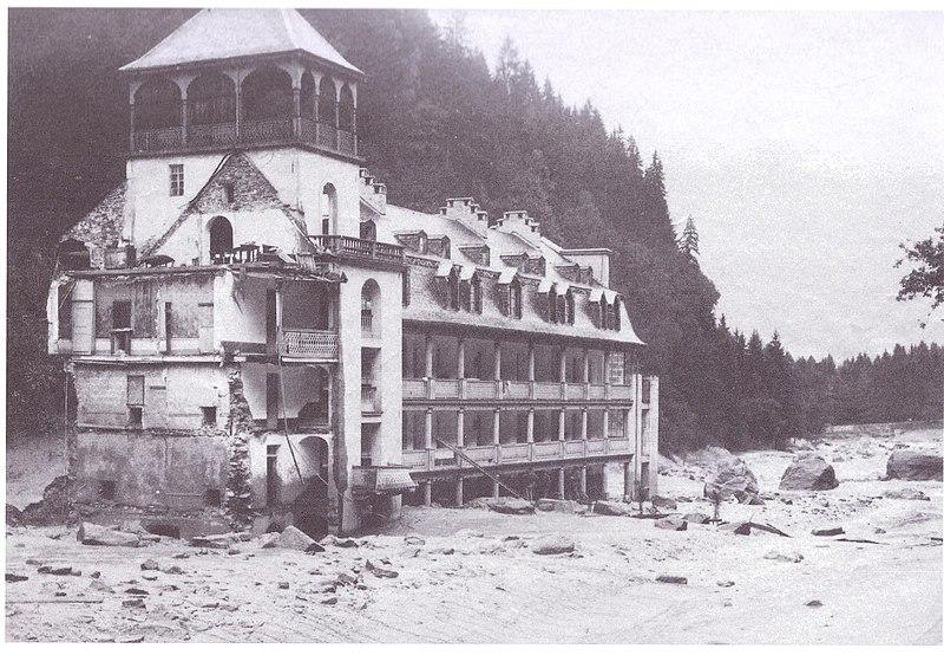
1892:[xii] ST GERVAIS DISASTER - FALL OF THE BIONNAY GLACIER
A SANITORIUM DESTROYED, ABOUT TWO HUNDRED LIVES LOST
Press Association—Electric Telegraph—Copyright
BERNE, July 13.
A portion of the Bionnay Glacier fell and diverted the floodwaters.
The St Gervais bathhouses, which were full of sleeping tourists, were destroyed.
It is feared that the death list will reach 200.
The water at St Gervais was a hundred feet deep. The physician who heard the noise saved fifteen persons by a timely alarm.
The catastrophe was caused by the glacier ice falling into and diverting a mountain torrent.
The accident happened at two o’clock in the morning, and was so sudden that half the village was demolished.
Another report carries more detail and it bears stunning similarity to the Nepal tragedy even though the world was colder then:[xiii]
The mechanism of the disaster, if we may put it in that way, was extremely simple. The hotel was in a narrow gorge which was over two thousand feet above sea level. Still higher was the waterfall which supplied the stream running through the gorge, and above this again towered the glacier of Bionnay, which forms one of the spurs of Mont Blanc.
The glacier had probably been loosened by the summer heats. At any rate, a huge fragment of it suddenly crashed down into the gorge and right into the bed of the torrent. It did not come alone. It carried away a sleeping village in its course, and the hideous ruin of ice, pulverised houses and dead men formed a dam into which the water rushed as into a reservoir.
The pent-up flood was the next agency of devastation. It burst its confines and poured down the gorge with all its burden of wreckage until it came full upon the hotel. The hotel consisted of five separate buildings, in which more than a hundred visitors or servants were at rest. Three of these buildings, with most if not all of their inmates, were destroyed outright, and their wreckage went to augment the destructive force of the torrent. Another was nearly destroyed, and only the remaining one escaped.
Between the hotel and the River Arve, lower down in the valley, there was another sleeping village, and this was doomed, like all else in the path of the flood. It was demolished in a moment, and its forty or fifty inhabitants were swept away. That was the night’s work. When the torrent at last lost its force in the river, it deposited a grisly burden of dead men and women and ruined homes.
No such story as this has come to us for many years from the region of ice and snow. Every circumstance of it is of unparalleled horror—its suddenness, the time of night, its very mystery, for the visitors, who were not acquainted with the region, could not have known with what force of Nature they had to deal. The unhappy peasants no doubt knew only too well.
When the villagers on the edge of the uppermost slope were awoke by the crash of the falling glacier, they must have realised at once the nature of their doom. The mountain had come down upon them, and they were beyond human help. They probably had but just time to turn in their beds and utter a prayer when all was over.
Their fate was in many respects more enviable than the fate of the unhappy creatures below, in the hotel. Here, as we know from the narrative of a survivor, destruction was not quite instantaneous. The first settlement was simply crushed, and its agony must have been as short as that of an insect under the heel of a giant.
The hotel was swept away by the water and the loosened rock, and before it quite yielded there was time enough for the inmates at once to realise the fact of their danger and yet to suffer the added torture of ignorance as to its cause. They heard the roar of the waters and the crash of the fragments of ice, but, for the moment, they could have had no more definite idea of their peril than that they were involved in the general ruin of a world.
One of the visitors at St Gervais-les-Bains, who was staying in that portion of the hotel which miraculously escaped destruction during the fearful catastrophe, gives the following account of the disaster:—
“In all, about eighty ladies and gentlemen who were taking a course of the waters sat down to table d’hôte in the hotel yesterday evening. The staff of the establishment numbered some twenty-five persons.
“I was somewhat fatigued after a long excursion which I made during the day and retired to bed at half-past ten. Suddenly, in the early morning, I was aroused from my sleep by a terrific shock, which seemed to shake the hotel to its foundations. The walls of my room were partly destroyed, and the furniture was thrown all about the place.
“I rushed to the window, the glass of which was completely shattered, and saw a huge volume of water rushing through the courtyard of the hotel with tremendous velocity and sweeping down with it large blocks of stone, some of which were as big as cottages. The roar made by the flood and the crashing of the rocks against each other were indescribable.
“Three of the five wings of which the hotel was composed were completely carried away with their contents, and furniture of every description was borne along in the waters. The fourth wing was partially destroyed, but that in which my room was situated escaped with comparatively little damage.
1910:[xiv] FLOOD FROM A GLACIER - AN UNIQUE AND TERRIBLE FORCE
By Cable—Press Association—Copyright
OTTAWA, November 25.
Floods due to the loosening of the waters inside a huge glacier swept the Behring River valley. Miners’ cabins were overwhelmed, and their fate is unknown. The river rose ten feet in four hours.
Great icebergs were torn off the glacier. Two prospectors, named Smith and Wise, are missing, and a search has been organised.
Icebergs swept down the river and carried off everything in their wild race downwards.
1912:[xv] SUDDEN FLOOD FOLLOWS BREAKING OF GLACIER BED
VANCOUVER, August 21.
Cable advices from Alaska announce that a glacier burst in the Lake District, causing the Copper River to rise 12ft in a few hours.
The railroad was partially swept away and a bridge destroyed. Extensive damage has been done.
It is not known if any lives have been lost.
1920:[xvi] GLACIER CAUSES FLOOD
GENEVA, September 26.
The bursting of a pocket on the Mont-Avert Glacier caused masses of ice to crash down the Arve River, flooding the valley, and it created great alarm at Chamonix—a town in Savoy, France, lying at the foot of the north-west slopes of Mont Blanc.—A. and N.Z. Cable.
1926:[xvii] THE RHONE DISASTER, NO SWISS LIVES LOST
(Per Press Association—Copyright.)
GENEVA, September 28.
The Rhone flood was due to a glacier pocket bursting a week ago. The debris blocked the ordinary bed of the Rhone.
Though the disaster is one of the greatest in the history of Switzerland, apparently not a life was lost.
The Simplon railway route will not be reopened for many weeks.
1929:[xviii] DASH FOR LIFE, MIGHTY INDUS IN FLOOD, ICE DAM BURSTS
CALCUTTA, August 20.
Owing to the bursting of the Shyok Glacier, the Indus, one of the great rivers of Asia, is pouring down in flood through the Kashmir reaches.
There were great precautionary activities in the Punjab and along the frontier to warn the inhabitants of the Indus Valley and to render them transport facilities.
Members of the Royal Air Force are being requisitioned to patrol the area likely to be affected.
Attock Bridge is being closely watched. By 8 a.m. yesterday the Indus had risen 16ft, and a further 6ft by 11 a.m., a further 4½ft by 2 p.m., and yet another 1ft by 5 p.m., and was then rising slowly.
The gauge reader at Khalsar, who originally reported the flood, speaks of a 50ft rise.
The deputy commissioner at Attock wires that all low-lying villages have been safely evacuated, without loss of life or cattle.
1936:[xix] BIG LANDSLIDE - TRAGEDY IN NORWAY
SEVENTY-FOUR PEOPLE KILLED, ENORMOUS DAMAGE
OSLO, September 13.
Amid widespread devastation, 74 people were killed, including 30 children, and 13 others were injured as the result of a huge landslide on the Raven Mountain, 6,000ft high, overhanging Lake Loen, six miles long, in the Nordfjord district, West Norway. The slide occurred at dawn directly opposite the village of Bodal.
The resultant waves demolished every house but one, killing and mutilating sleeping inmates, laying waste farms, sinking boats and destroying bridges.
Only three houses remain in the lakeside village of Nesdal. The bodies of two dwellers in a house on the hillside two miles distant were recovered from the river which flows into the lake. The pavilion at Kjøndal Glacier was demolished.
The mass of earth and debris which fell into the lake was 2,500ft high and 1,000ft wide. Flood waves hurled some of the injured 300 yards and wrecked everything for a mile inland from Bodal, including an electricity station and sawmills.
Many families are ruined. The damage is estimated at £30,000.
Medical aid was despatched by air from Bergen and by ship from Oslo. A similar disaster resulted in 60 deaths in 1905.
In summary, glacier collapses and floods have happened frequently, but more often in our colder past. There are clear scientific reasons for this. Rushing to pin every such collapse on climate change is the activist equivalent of barking at every passing car.
[i] “Lure of the Wild”, E E Muir, Evening Post, 30 December 1931
[ii][ii] “The Hermitage”, Timaru Herald, 6 January 1913
[iii] “Heavy rain”, Dominion, 21 January 1913
[iv] “Damage at the Hermitage”, Ashburton Guardian, 23 January 1913
[v] “Letter to the Editor”, E H Shepard, Timaru Herald, 27 January 1913
[vi] “Disastrous Storm — Tremendous Downpour at Mount Cook”, Christchurch Star, 29 March 1913
[vii] “The Rocky Road”, Lyttelton Times, 3 April 1913
[viii] Veh, G., Wang, B.G., Zirzow, A. et al. Progressively smaller glacier lake outburst floods despite worldwide growth in lake area. Nat Water 3, 271–283 (2025). https://doi.org/10.1038/s44221-025-00388-w
[ix] Harrison, S. et al, Climate change and the global pattern of moraine-dammed glacial lake outburst floods, The Cryosphere, 12, 1195–1209, https://doi.org/10.5194/tc-12-1195-2018 , 2018.
[x] “Canadian disaster”, North Otago Times, 22 October 1903
[xi] “Bursting of a Swiss Glacier”, Auckland Star, 8 November 1890
[xii] “St Gervais Disaster”, NZ Herald, 15 July 1892
[xiii] “Terrible Catastrophe in the Alps”, Tuapeka Times, 14 September 1892
[xiv] “Flood from a Glacier”, Taranaki Daily News, 28 November 1910
[xv] “Sudden flood” New Zealand Times, 23 August 1912
[xvi] Otago Daily Times, 28 September 1920
[xvii] “The Rhone Disaster — No Swiss Lives Lost”, Ashburton Guardian, 30 September 1926
[xviii] “Dash for life”, Waihi Daily Telegraph, 12 September 1929
[xix] “Big Landslide — Tragedy in Norway”, Bay of Plenty Times, 15 September 1936
Community Discussion
Comment Policy