Minor parties, major trade-offs
October 5, 2026

In brief
Outdoors & Freedom and Conservative Party NZ offer distinctive policies, but face a steep climb into Parliament.
NZ First overlaps with Outdoors & Freedom on COVID scrutiny and leaving the Paris Agreement; the Greens share ground on cannabis and marine protection.
ACT overlaps with the Conservatives on smaller government, equal treatment and free speech, but assisted dying is a serious dividing line.
The overhang debate poses an awkward question for voters loyal to small parties. Should they support the platform they most believe in, or a parliamentary party that might actually be able to deliver some of it, because they will be in parliament?
The overhang discussion has reached the political heavyweights. John Key called National supporters splitting their vote “the opposite of clever”, warning that talented National MPs could lose their seats. Winston Peters responded, saying: “You don’t just carry on with previous ways as if it doesn’t matter.” Peter Williams also challenged Key, arguing that splitting the vote could give the centre-right enough MPs to stay in government.
We have chosen, in this article, to focus on just two of the small parties, the NZ Outdoors & Freedom Party and Conservative NZ Party. How much of their politics already exists in parties already in Parliament?
The overlap and contrast below is our high level assessment of published policies.
First get the electoral maths right
Under MMP’s rules, a party needs at least 5% of the party vote or an electorate victory to qualify for list seats. A party finishing below 5%, without an electorate, elects nobody. Its votes do not transfer to a second choice.
The strategy being discussed on the right pairs an electorate vote for National with a party vote for ACT or NZ First. If National wins more electorates than its party vote entitles it to, those MPs keep their seats and Parliament expands.
Outdoors & Freedom crosses the usual political dividing lines
The party’s current centrepiece is direct democracy: binding citizen votes to veto legislation or propose laws, stronger local control and making the Bill of Rights supreme law. They are unique in that.
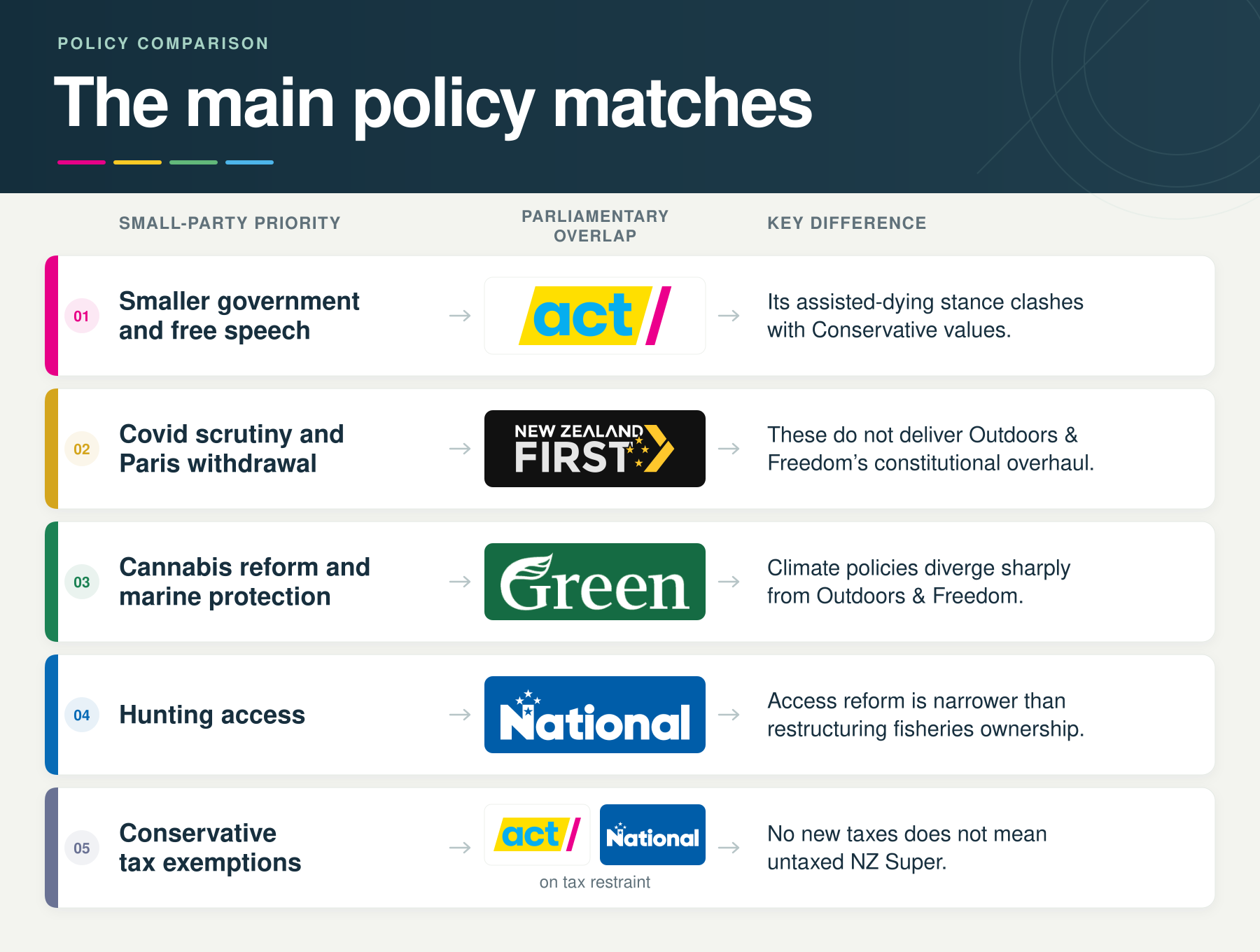
NZ First offers a clear overlap on pandemic accountability. In March, it called for a select committee inquiry into vaccine injuries. Both Outdoors & Freedom and NZ First want to leave the Paris Agreement. These overlaps do not deliver Outdoors & Freedom’s constitutional programme, including citizen vetoes, citizen-proposed laws and making the Bill of Rights supreme law.
Outdoors & Freedom also supports decriminalising personal cannabis cultivation and possession and fisheries reform favouring abundance and recreational access. The Greens support legal cannabis regulation and phasing out bottom trawling. Those are meaningful overlaps, although leaving Paris would put the parties sharply at odds.
The Conservatives share economic ground but draw social boundaries
The Conservatives’ policy overview favours lower taxes, limited government and equality before the law. ACT’s emphasis on services based on need rather than race and its free-speech proposal supply clear points of comparison.
The Conservatives’ child-protection policy stresses parental involvement, transparent sexuality education and restrictions on elective, irreversible procedures involving minors. NZ First’s opposition to puberty blockers for children offers overlap on that front.
But ACT is a much harder fit on assisted dying. The Conservatives list “Valuing life from conception to natural death” among their beliefs. ACT wants broader access to assisted dying, including replacing the six-month prognosis requirement.
Influence comes with a trade-off
Small parties can develop ideas and pressure bigger parties to respond. Supporting them can serve that purpose even when Parliament remains out of reach. Tactical voting pursues a more immediate result, while accepting compromises, which is somewhat the nature of politics.
Community Discussion
Comment Policy