Explainer: How tactical voting could produce a 191-seat Parliament
October 5, 2026

In brief
Voters can support one party locally and another with their party vote. If the first party wins more electorates than its party vote entitles it to, Parliament grows.
The most extreme theoretical scenario could produce 191 MPs: 120 MPs elected from party lists, plus 71 electorate winners whose parties submit lists but receive no party votes.
Te Pāti Māori provides the left with an existing way to pursue this strategy. Both sides could try it.
Where the 120-seat base comes from
New Zealand’s electoral law uses 120 MPs as Parliament’s normal starting point. As Parliament’s official explanation sets out, the Electoral Act provides a formula based on that number, with the final total able to increase or decrease in certain circumstances.
The number of electorates is calculated separately using census and electoral-roll data. For 2026, there are 71 electorates, normally leaving 49 list MPs to complete the 120-seat House.
The party vote divides the normal 120 seats between qualifying parties. Electorate winners fill each party’s allocation first, and list MPs fill any gap.
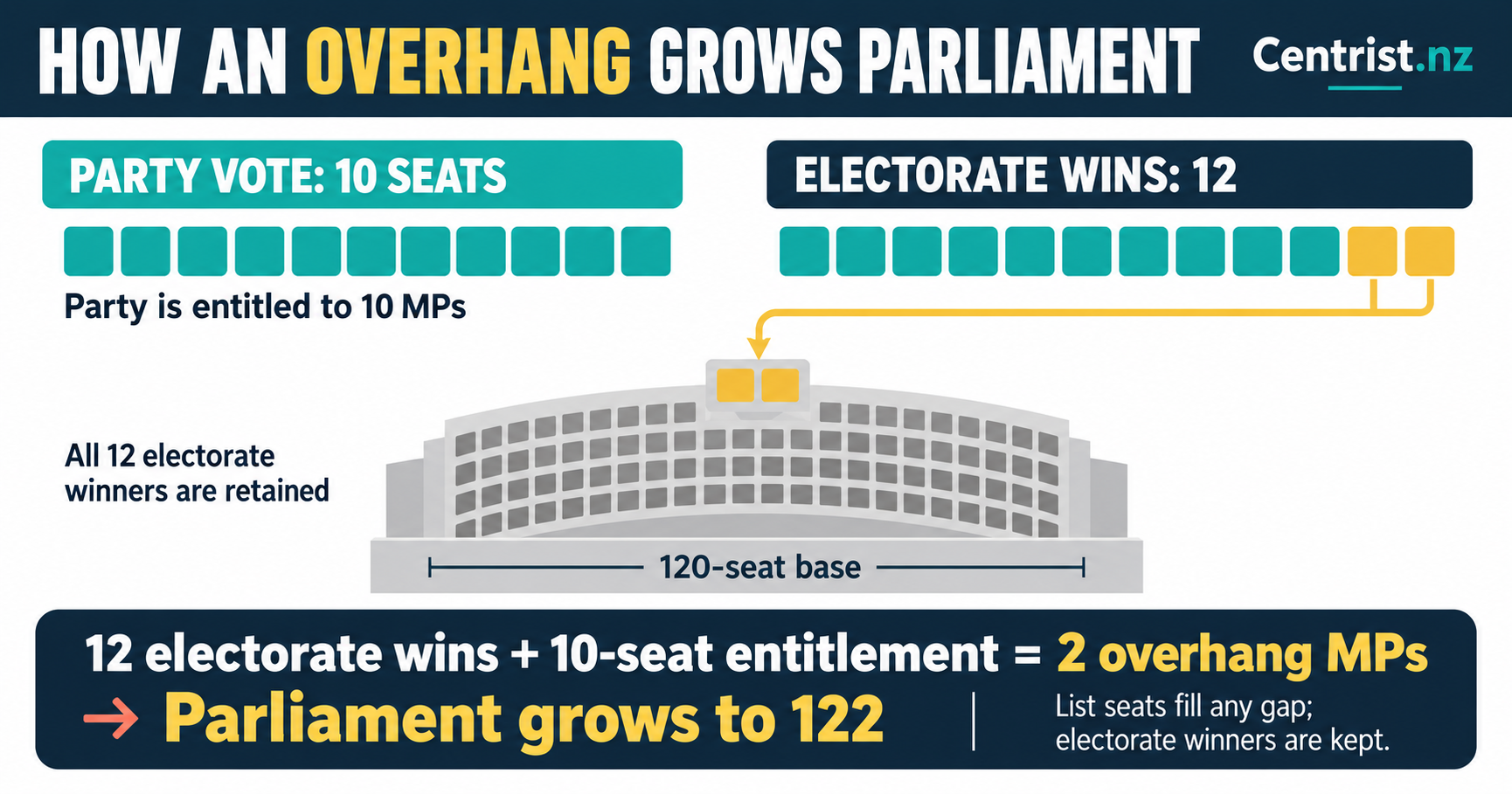
A party entitled to 10 MPs that wins six electorates gets four list MPs. If it wins 12 electorates, it keeps all 12 and gets no list MPs. The other parties are allocated 110 seats. However, keeping Parliament at 120 would leave only 108 seats for the others, two fewer than their party votes earned.
The two excess seats create an overhang to accommodate the electorate winners without taking seats away from other parties. The Electoral Commission explains this process here.
Forty-nine is the usual number of list MPs, but an overhang can increase that number. The number of list MPs is increased so other parties keep the electoral seats their party earned.
Why the theoretical total is 191
Suppose the parties winning all 71 electorates submit valid party lists but receive zero party votes. Their 71 electorate seats would all become overhang seats. Other qualifying parties would fill the normal 120 seats from their lists, provided they had enough candidates. Parliament would then have 120 list MPs plus 71 electorate MPs: 191 in total.
Two different voting strategies
One approach changes the electorate vote. Supporters of smaller parties could keep their party vote but back a stronger allied candidate locally. That might help the candidate win, although it would not necessarily increase their political bloc’s total seats.
The other approach changes the party vote. National supporters could keep voting for National candidates locally while giving their party votes to ACT or NZ First. Labour supporters could similarly keep backing Labour candidates while giving their party votes to the Greens.
If National or Labour still won enough electorates, their reduced party votes could create overhang seats.
Their allies would meanwhile receive seats through the transferred party vote.
Both approaches could operate together, involving different groups of voters.
Te Pāti Māori gives the left an existing opening
Te Pāti Māori already demonstrates the underlying pattern. In 2023, it won six electorates while its party vote entitled it to four seats. It kept all six MPs, creating a two-seat overhang.
For 2026, it is explicitly encouraging supporters to give their electorate vote to Te Pāti Māori and their party vote to Labour or the Greens. Its October 4 list announcement reaffirmed that strategy.
TPM’s vote-splitting strategy does not prove the left would gain more from overhangs than the right. National and Labour supporters could also split their votes to try to create extra seats, and either side could respond to the other. The overall advantage would depend on how voters actually voted.
Why even a tiny list matters
Retaining a party list matters. Without a list, five electorate wins give a party five MPs within the normal 120, leaving 115 seats for other parties. With a list, if its party vote earns it two seats but it wins five electorates, the three extra seats take Parliament to 123. Even a tiny list keeps that overhang option open.
More MPs also means a higher majority line. The result would depend on voters cooperating, candidates winning their electorates and the resulting parties agreeing to work together.
Community Discussion
Comment Policy