Auckland one of world's most thieving cities
August 11, 2026
The Economist has just published a crime comparison of 20 OECD cities.
New Zealand wasn't on the list as the cut off was cities with a population of 2.5 million... so I asked GPT to analyze the Auckland crime stats and write me a report... which follows.
Key point? Auckland has a burglary rate to rival the highest in the survey, and a car theft rate that may also match. But as for violence, we're nowhere near the worst:
MEAN STREETS?
Aucklanders think crime is bad. Then you compare us with London, Paris and Chicago
A remarkable new international crime study has attempted something statisticians usually warn against: comparing crime rates across the world's great cities. We added Auckland to the table. The results are startling.
Spend enough time scrolling social media and you could be forgiven for thinking Western civilisation has become one enormous crime scene.
London is supposedly overrun by knife-wielding gangs. American cities are awash with guns. Paris has pickpockets and street robbers. Auckland has ram-raiders, shootings, burglaries and stolen cars.
But how dangerous are these cities really?
The Economist has just published one of the more interesting attempts to answer that question, using a new international dataset assembled by University College London criminologist Matt Ashby and colleagues.
Its headline question was simple: “Is Europe safer than America?”
The answer turns out to be: it depends what you mean by “safe”.
And when we added Auckland to the comparison, New Zealand's largest city produced a fascinating result.
If you are worried about being murdered or robbed, Auckland appears remarkably safe by big-city international standards.
If you're worried about someone stealing your car or burgling your house, however, that's another matter entirely.

DEADLY AMERICA
Comparing international crime statistics is notoriously difficult.
A stolen phone might be reported in one country but not another. Police classifications vary. What one jurisdiction calls robbery another may classify differently. Even city boundaries create statistical distortions.
Ashby's researchers attempted to minimise those problems.
They selected 20 large cities in wealthy countries, harmonised crime definitions and adjusted geographical boundaries so that they were comparing meaningful urban areas rather than arbitrary municipal lines.
One statistic nevertheless travels particularly well across borders: homicide.
As The Economist rather memorably put it, “a dead body is a dead body”.
And on homicide, the American-European divide is enormous.
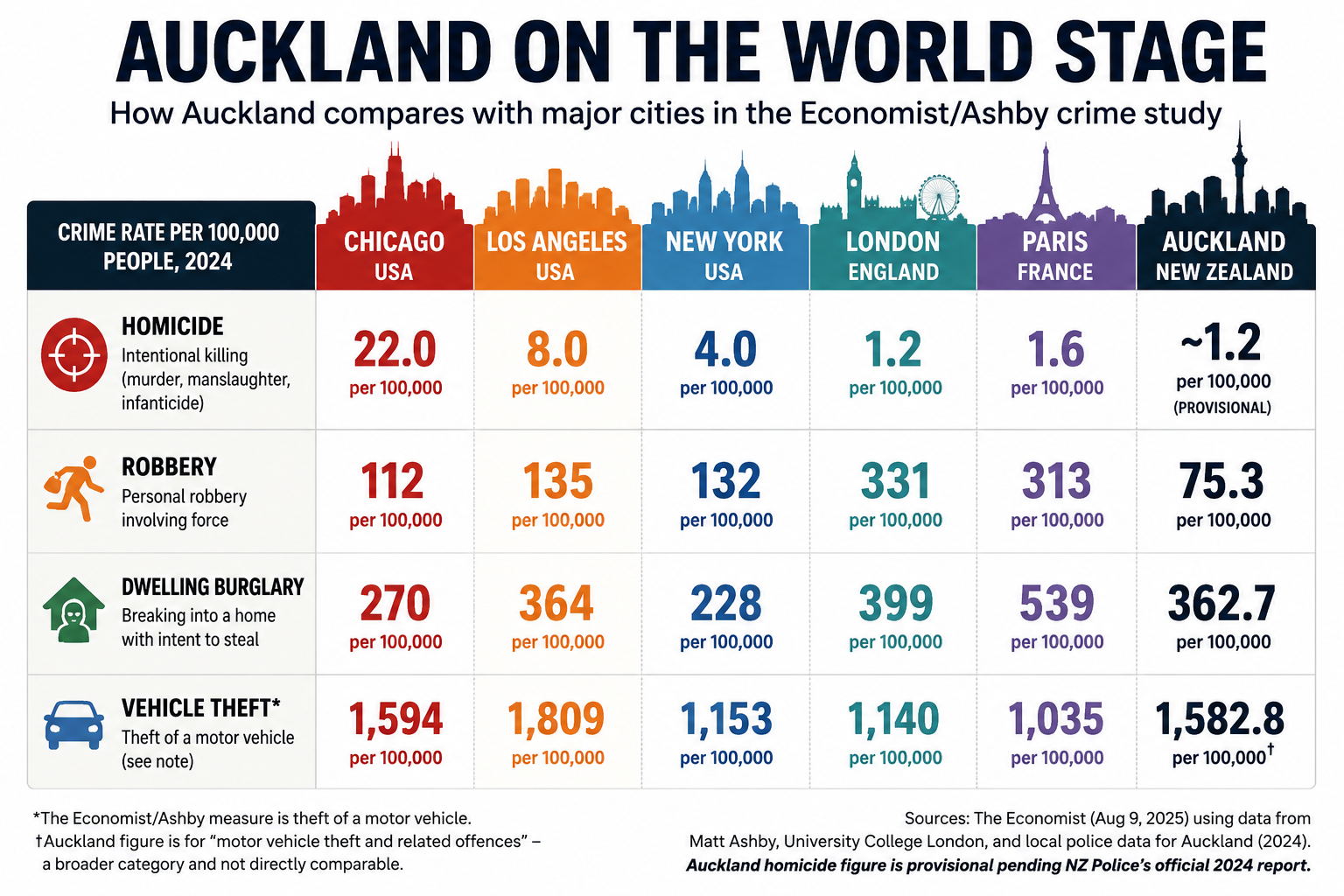
Chicago recorded 587 homicides during 2024, equivalent to: 22 homicides per 100,000 people.
Los Angeles was the second deadliest city in the study at around eight per 100,000.
The ten European cities, by contrast, averaged only: 1.7 per 100,000.
That's not a small difference.
Chicago's homicide rate was roughly 13 times the European average.
But then things get interesting.
Move away from murder and America's apparent crime disadvantage begins disappearing.
Personal robbery involving force occurs at surprisingly similar rates across the Atlantic.
Indeed, two of Europe's most famous cities are among the worst performers.
London and Paris each recorded more than 300 personal robberies per 100,000 people.
Residential burglary was actually more prevalent in Europe.
Vehicle theft was high in Chicago and Los Angeles, but New York performed better than many European cities.
In other words, there isn't really one phenomenon called “crime”.
Cities have crime fingerprints.
Which raises the obvious question:
What does Auckland's fingerprint look like?
ADDING AUCKLAND
We obtained New Zealand Police recorded-victimisation data for 2024 covering the three Police districts making up greater Auckland: Auckland City, Counties Manukau and Waitematā.
Using Auckland's estimated population of approximately 1.798 million, we then calculated equivalent rates per 100,000 residents.
The first result was remarkable.
Across the three Auckland districts, Police recorded 1,355 robberies during 2024.
That equals: 75.3 robberies per 100,000 people.
Compare that with more than 300 in London and Paris.
On the recorded figures, therefore, an Aucklander's robbery risk is only around one quarter of that indicated for London or Paris in the Economist comparison.
There are caveats.
Crime-reporting rates vary between countries. Some victims never contact Police. Legal definitions and recording procedures can never be made perfectly identical.
Ashby himself describes international comparisons as essentially a “least-worst” exercise.
But a gulf between approximately 75 and more than 300 is nevertheless striking.
The popular image of Auckland as a particularly dangerous street-crime city simply isn't obvious in the robbery statistics.
WHAT ABOUT MURDER?
Here the comparison becomes even more dramatic.
New Zealand Police has not yet published its official Homicide Victims Report for 2024; its latest published report covers 2023 and records a provisional national total of 86 homicide victims.
We therefore reconstructed Auckland's 2024 homicide total from individual Police homicide investigations.
Our provisional audit identifies approximately 21 victims across the three Auckland districts.
That works out at: approximately 1.2 homicides per 100,000 Aucklanders.
The figure must remain provisional until Police publishes its official 2024 homicide statistics, because cases can subsequently be reclassified.
But the international comparison is extraordinary.
Chicago: 22
Los Angeles: ~8
European ten-city average: 1.7
Auckland: ~1.2
Chicago's homicide rate was approximately 19 times Auckland's.
Even more surprisingly, Auckland appears to have had a homicide rate about 30% below the average of the ten European cities studied by The Economist.
And homicide is arguably the strongest statistic in the entire exercise because differences in crime reporting matter much less.
People may decide not to report a stolen phone.
Murders are rather harder to conceal from the statistics.
THEN THE HALO SLIPS
If Auckland looks remarkably good on lethal violence and robbery, property crime tells a less flattering story.
During 2024, Police recorded 6,523 burglaries of dwellings across Auckland City, Counties Manukau and Waitematā.
That's: 362.7 dwelling burglaries per 100,000 residents.
And then we come to vehicles.
The three Auckland Police districts recorded an extraordinary 28,463 victimisations in the category “motor vehicle theft and related offences”.
That translates to: 1,582.8 per 100,000 residents.
Before anyone starts claiming Auckland has the world's worst car-theft problem, however, an important warning is required.
The New Zealand category is broader than the harmonised vehicle-theft definition used by Ashby. It includes “related offences”, so the Auckland figure cannot legitimately be placed directly alongside the international vehicle-theft numbers.
We need finer-grained Police data separating actual theft of motor vehicles before making that comparison.
Nevertheless, 28,463 recorded victimisations in one year suggests Aucklanders complaining about vehicle crime aren't imagining the problem.
AUCKLAND'S CRIME FINGERPRINT
Put everything together and Auckland looks quite different from the stereotype.
AUCKLAND 2024
Crime| Victims| Rate per 100,000
Homicide*| ~21| ~1.2
Robbery| 1,355| 75.3
Dwelling burglary| 6,523| 362.7
Motor vehicle theft & related†| 28,463| 1,582.8
Provisional reconstruction pending Police's official 2024 homicide report.
†Broader than the Economist/Ashby vehicle-theft definition and therefore not directly comparable.
Auckland's apparent crime fingerprint could therefore be summarised like this:
Very low homicide.
Relatively low robbery.
Significant burglary.
Very substantial vehicle crime.
That produces an apparent paradox.
An Aucklander can quite reasonably believe crime is a serious problem because cars are being stolen and houses burgled while simultaneously living in one of the safer major Western cities when it comes to being murdered or robbed.
Both propositions can be true.
PERCEPTION VERSUS RISK
There's another reason Aucklanders might perceive their city as more dangerous than the statistics suggest.
Twenty-one homicides are twenty-one human tragedies, and spectacular crimes naturally dominate news coverage.
A fatal shooting on Ponsonby Road understandably attracts vastly more attention than thousands of Aucklanders who go out that night and return home safely.
Other 2024 homicide investigations included killings in Blockhouse Bay, Grey Lynn, Onehunga and Point England. Police records confirm these were separate homicide investigations, illustrating why highly visible violence can shape public perception even when the population-wide homicide rate remains low.
There's also an important distinction between homicide and danger from strangers.
NZ Police's historical homicide statistics show that many victims are killed in family or other interpersonal circumstances rather than random attacks. Around 15% of homicides nationally involve current or former partners, for example.
Consequently, Auckland's roughly 1.2-per-100,000 homicide rate actually overstates the risk that an ordinary person walking down Queen Street will be randomly murdered.
SO, IS AUCKLAND SAFE?
That's the wrong question.
The Economist study demonstrates why.
Ask instead: Safe from what?
If you're talking about murder, Auckland appears remarkably safe.
If you're talking about robbery, Auckland's recorded rate appears dramatically lower than London and Paris.
If you're talking about residential burglary, the picture deteriorates.
And if you've just looked out the window and discovered your Toyota Aqua is no longer where you parked it, international homicide comparisons probably won't make you feel much better.
Crime statistics don't tell us Auckland has no crime problem.
They tell us something more useful.
Auckland has a particular kind of crime problem.
And whatever else may be going wrong in New Zealand's biggest city, the available evidence suggests one thing fairly clearly:
Auckland isn't Chicago.
Not even close.
Community Discussion
Comment Policy