$1.2m worth of airtime? What Opportunity's news coverage might have cost
November 28, 2026

Summarised by Centrist
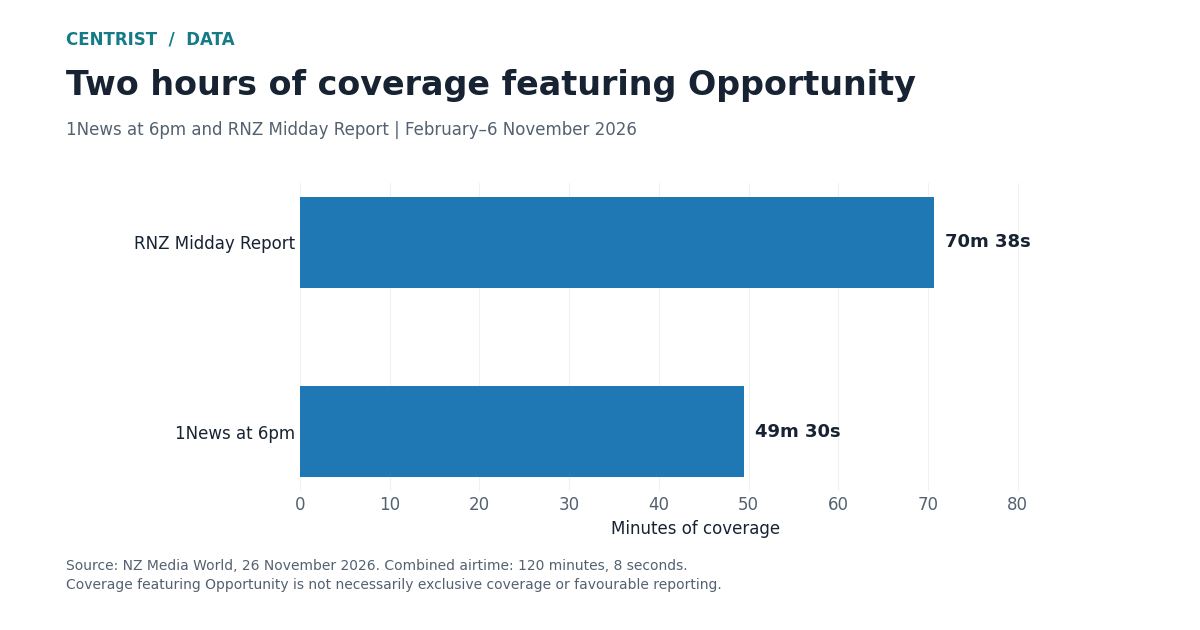
The Opportunity Party received approximately two hours of coverage across two state-owned broadcasters in the lead-up to the 2026 election, while 11 other minor parties received none within the coverage measured, according to analysis by NZ Media World.
The estimated advertising-equivalent value of Opportunity's television coverage alone was approximately $1.2 million — ten times its official election broadcasting allocation.
NZ Media World researcher Brynn Neilson analysed transcripts from 1News' 6pm bulletin and RNZ's Midday Report between February and 6 November 2026.
Opportunity featured in 107 stories longer than 30 seconds, receiving 49 minutes and 30 seconds of television coverage and 70 minutes and 38 seconds of radio coverage.
“In the month of February, Opportunity got three news reports. In the month of March, it got 12,” Neilson told The Platform's Michael Laws.
“And you have to ask yourself, no other minor parties were getting reported at the time. How does this influence the election?”
Using published TVNZ primetime advertising rates, Neilson estimated the equivalent commercial value of the television airtime at between $790,000 and $2.2 million.
This compares with Opportunity's Electoral Commission broadcasting allocation of $118,755. Under electoral broadcasting restrictions, parties cannot simply use their own campaign funds to purchase additional election advertising airtime on television and radio.
In a separate analysis covering 25 September to 24 October, Neilson used artificial intelligence to classify 30-second segments of political coverage as favourable, unfavourable or neutral.
The results showed a substantial disparity between the amount of favourable coverage received by Opportunity and the Greens compared with ACT and New Zealand First.
“Over that month in total TOP got 17 minutes of favourable coverage, the Greens got 16.1 minutes, ACT got 2.8 minutes and NZ First got two minutes,” said Neilson.
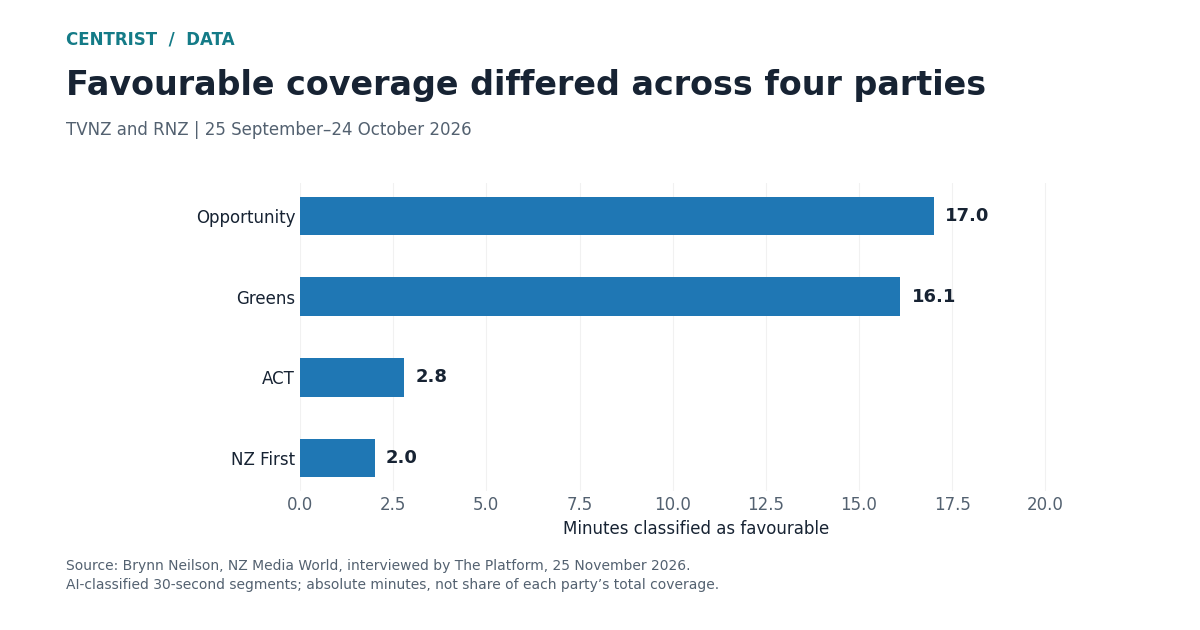
Opportunity received more than eight times as much favourable coverage as NZ First during the period.
Neilson advocates making state broadcasters' news archives publicly accessible through an institution such as the National Library, enabling independent scrutiny of their reporting.
“I think that information should be available not only to the government, it should be available to all New Zealanders,” he said.
Neilson acknowledges that news coverage is not advertising and that advertising-value equivalence is an approximate and disputed measure.
Editor's note: NZ Media World's analysis measures the amount of airtime allocated to parties and the tone of that coverage.
While the airtime disparity is quantifiable, AI-based sentiment classification involves interpretative judgements. Neither analysis establishes how many votes Opportunity gained as a consequence of its media exposure.
The most substantial finding is arguably not the hypothetical dollar value, but the difference between 107 stories for one previously non-parliamentary party and zero for 11 others across the two programmes examined. That is a finding that does not depend on AI interpreting political sentiment.
Read more at NZ Media World | The Platform
Community Discussion
Comment Policy